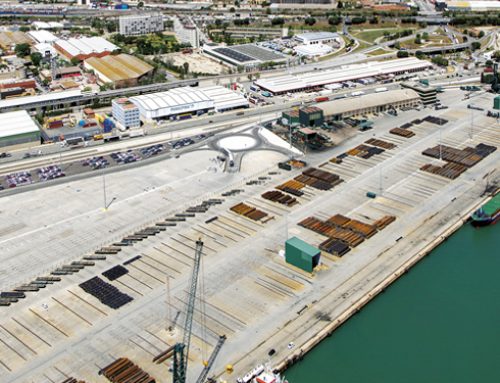

Both additions are part of the company’s investment plan in the Canary Islands, with more than €40 million allocated to the modernisation of Boluda Maritime Terminals Tenerife. The arrival of the two STS gantry cranes complements the existing fleet of four hybrid RTG cranes, strengthening operational capacity and positioning the terminal among those capable of handling Ultra Large Container Vessels (ULCV).
This morning, the presentation ceremony for the two Super Post‑Panamax Ship to Shore (STS) cranes took place at the Boluda Maritime Terminals Tenerife facilities, located at the Bufadero quay. These cranes will become part of the skyline of the Port of Santa Cruz de Tenerife.
The event, led by Javier Climent, Managing Director of Boluda Shipping, was also attended by Pedro Suárez López de Vergara, President of the Port Authority of Tenerife, and Antolín Goya, General Coordinator of the Coordinadora Estatal de Trabajadores del Mar (CETM) and the Port Dockworkers’ organisation (CEEP).
According to Javier Climent, Managing Director of Boluda Shipping, “this investment strengthens Boluda’s operational capacity in Tenerife, enabling the handling of large vessels such as Ultra Large Container Vessels (ULCV), and consolidating Tenerife as a hub prepared to manage high-volume calls.”
For Pedro Suárez, President of the Port Authority of Santa Cruz de Tenerife, “this investment reflects the confidence of private operators in the present and future of our port. Strengthening the capacity and efficiency of our terminals is key to consolidating this role, offering shipping lines and operators a competitive and safe service, particularly in an international context where logistics efficiency, operational safety and sustainability are increasingly decisive factors.”
A change in the port skyline
The Ship to Shore (STS) cranes incorporate state-of-the-art technology designed to maximise safety and operational efficiency, enabling more precise and reliable cargo handling. This new scenario represents a strategic opportunity for major shipping lines, which are currently reconfiguring their routes to Europe via the Cape of Good Hope.
In this context, the Port of Santa Cruz de Tenerife is strengthening its position as a key call in these routes, offering the capacity, infrastructure and performance required to ensure agile and competitive operations.
Key features include an outreach of up to 22 containers across, a total lifting height of 60 metres, twin-lift handling capacity of up to 71 tonnes and a maximum lifting capacity of 88 tonnes under the hook, allowing both containerised cargo and large project cargo to be handled.
In addition, the cranes are equipped with advanced control and power systems with energy regeneration to the grid, contributing to reduced carbon footprint and lower environmental impact of port activities.
Hybrid RTG technology
The newly arrived STS cranes are complemented by the efficiency of four new-generation hybrid RTG (Rubber Tyred Gantry) cranes from Konecranes, already operating at full capacity at the Tenerife terminal. These increase container storage capacity while improving efficiency, agility and safety in loading and unloading operations.
RTG cranes stand out for their sustainability, as well as enhanced productivity and speed. They optimise the movements of both crane operators and transport equipment, reducing operational times. They also increase yard capacity by enabling an additional stacking level and facilitate container handling and delivery, significantly improving gate operations.
This improvement in storage management directly optimises cargo reception and delivery flows, reducing waiting times and enhancing overall terminal efficiency.
With these additions, Boluda continues to modernise its infrastructure in the Canary Islands, strengthening its ability to respond to growing port traffic while offering an even more agile, competitive and efficient service. This progress contributes to consolidating the Port of Tenerife as a strategic platform for international maritime traffic, at the forefront of the sector’s logistics and port needs.